I
wrote this last week while traveling to DC, 10 days before my Mom died. I never
posted it. But 24 hours after losing her I picked this up again. I never
thought that when I was writing it she would be gone by the time I hit “post.”
-------------------------------------------------------------------------------------
Hudson, my nearly 3-year-old nephew, sat
next to me nestled under the crook of my arm while he watched intently, but
not without concern, as my brother Michael, his, “Uh Uh” (uncle) suctioned my
Mom. She was hyperventilating and he was trying to clear secretions with a
suction machine, which entails a suction tube being inserted down her throat.
She was on her BiPap (breathing machine), and I had given her morphine and other
anxiety medications to try and calm her down. Her color was changing and her
lips were turning blue. It was incredibly scary to watch.

Would this be The Moment?
ALS does not go quietly into the night. The
end is not pretty.
It is awful.

Hudson turned to me, “Ah-Ah?” (What he calls me):
“Why-eee Uh-Uh shhh shhh?” as he made his best attempt to
mimic the suctioning sound.
“Because
Nana can’t breathe very well, so he is helping her.”
“Why-eee?”
My brother turned around, “Don’t worry, Hudson, I am not hurting
Nana, I am helping her.”
“Why-eee?”
I explained to Hudson, “Grandma’s lungs don’t work very well, so she needs help to breathe
sometimes.”
“Why-eee?”
“She
has an owie in her lungs.”
I put my hand and then his hand over his
lungs, and told him to take a deep breath. I tried to explain in an age-appropriate way how lungs worked and
that “Nana” (he can’t say Grandma or Grandpa, so calls them Nana and Papa)
needed help to have her lungs work.


“Uh-Uh help Nana” he said, more as a statement than a
question.
“Yep,
Hudson, Uncle is helping Nana.”
“Why-eee?”
“Because
Nana has something called ALS, which gave her the owies in her lungs.”
“Why-eee?”
“I
don’t know Hudson. Sometimes it just happens, and we don’t know why Grandma got
ALS.”
“Ohhhh. Ohhkay.”
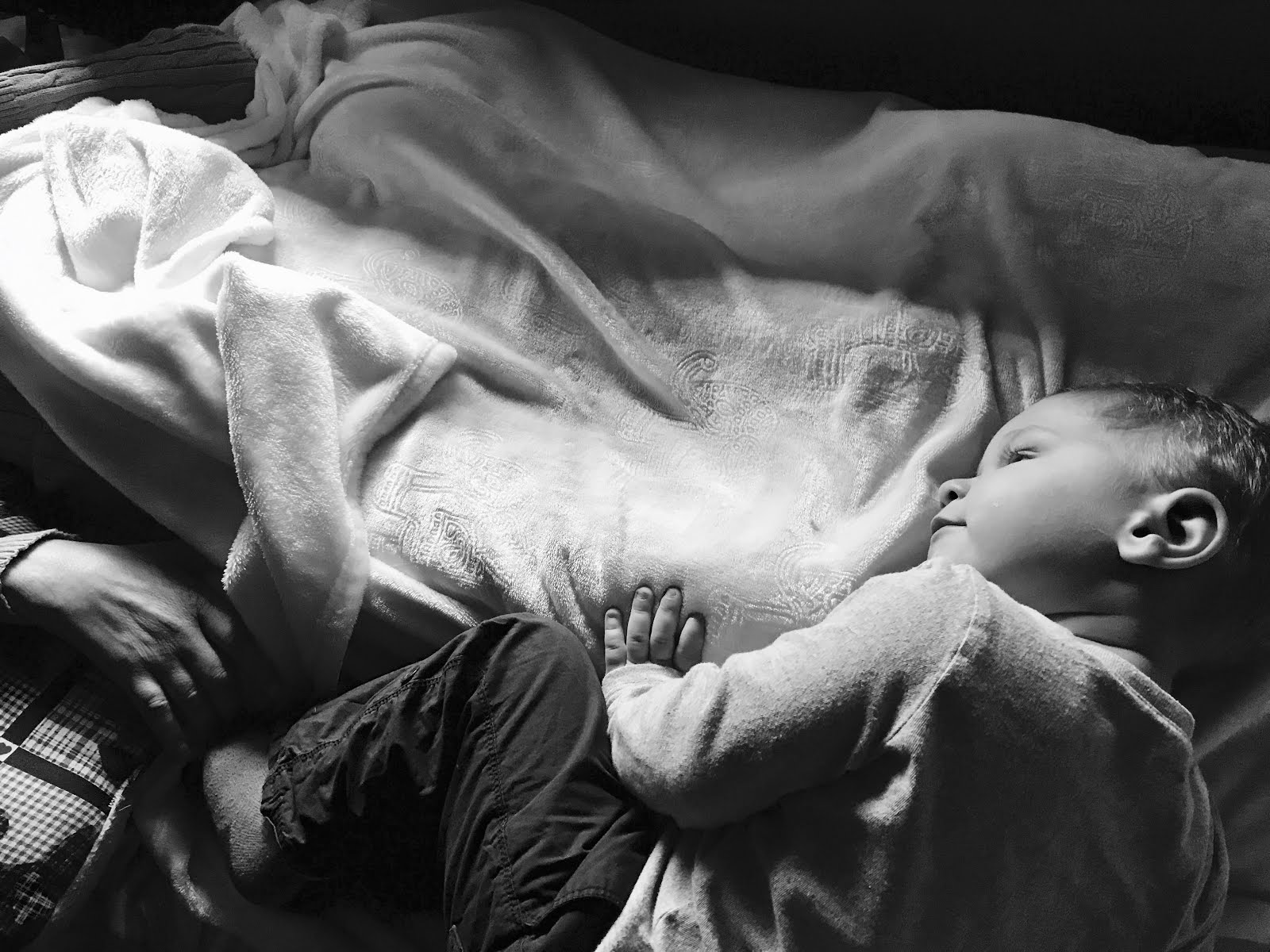 |
| Her hand reached to touch his toes. An extraordinary act of love because it was an extraordinary physical feat. It is like taking a bullet each time I look at it. |
-------------------------------------------------------------------------------------
I sit here writing this from seat 6F; the
bulkhead of an Alaska Airlines flight bound for DC. I wasn’t sure if I would
make it here, on my way across the country to DC to see one of my very best
friends, Erin, graduate from residency, and then onto Toronto for a conference.
My Mom is not doing well; she is at the end by any measure. There have been
untold times over the last 5-6 weeks where we thought; the moment is now, today
is the day, this is the weekend.
She has surprised us time and time again,
pulling through when even Hospice thought she wouldn't.
ALS is a tricky disease; it is hard to
predict and doesn’t frequently adhere to the usual predictable patterns of
death.
If being honest with you all, and with
myself, when I planned this trip months and months ago, I assumed my Mom would
be gone. We’ve always known we would never be able to predict when she would
go, but we also never predicted how difficult it would be to tell when the end
was near.
-------------------------------------------------------------------------------------
My Mom was diagnosed with ALS in November
2013, and the road has been unimaginably long.
This long road has afforded us the luxury
of time; but it has not come without a heavy toll. I, along with every member
of my family, have been in active states of mourning for nearly four years.
That is a long time to mourn and be sad; it is a unique state of being that
most will never experience, thankfully.
Whether thankfully or unfortunately,
depending on your individual take, many people die quickly. Perhaps they go
without warning; maybe it is a sudden heart attack, a fall down the stairs, or a
car accident. Even with a diagnosis like cancer, a prolonged state of dying
with no potential of recovery is exceedingly rare. If it isn’t obvious, let me
be clear:
It is hard. It is excruciatingly difficult
to slowly watch someone slip through your fingers.
-------------------------------------------------------------------------------------
I was at dinner with one of my dearest
friends, Jessica, the other day. I was recounting the years of ALS. She asked
when exactly my Mom had been diagnosed. Jessica and I have been friends for 2
years, and as such, my Mom was already sick when I met her. When I told her the
length she simply, yet eloquently stated:
“You’ve
been grieving for a long time. Almost 4 years is a long time.”
It IS
a long time. I realized in that moment, that my Mom has been dying for
approximately 12% of my life, which I blurted aloud.
My brain sometimes works in weird ways.
I rehashed each year of her ALS diagnosis,
its own unique epoch; hard and beautiful in their own ways:
Year
1:


Year 1 was simultaneously
the most awful, horrific, life-flipping year of the disease, yet also wonderful
and full of living life to the edges. We were all still in shock, actively mourning
and actively reimagining our lives without her. It was also what is termed that,
“Golden Year” in ALS – when you have the diagnosis and know you will die, but
still have some time left to live life, say the things you need and want to
say, do the things you always meant to do. In Year 1, I was personally a wreck.
A professional Hot Mess if you will. I also am a person of action and a do-er.
So I did what I do best and sprang into action to get her into the care of one of the
world’s leading ALS doctors and started planning trips. In Year 1, just weeks after the diagnosis in November, myself, my
Mom, sister, and two Aunts took a girl’s trip to Walla Walla for wine-tasting.


My sister announced she was pregnant around Christmas, which was such an incredible ray of light in the dark early days.

The holidays in Year 1 were simultaneously disorienting and magical, no one could avoid thinking about how many more we
might have and what they would look like when she is gone.


In January, I took my Mom to
Disneyworld and Florida with Colin.



In April, she, my
brother and I gallivanted across Italy and Greece for over two weeks, visiting Santorini,
Rome, Tuscany, Florence, Pisa, and Venice.


In
June, we celebrated my Mom’s 60th birthday with a massive 60th
birthday surprise blowout and then as a family in Kauai and Oahu, which also
marked my Mom’s early retirement.


=


Then
we all experienced the joy of Hudson being born in August, giving my Mom a new title: Grandma.
 |
| Jennifer's Baby Shower |

 |
| My absolute favorite photo of my Mom <3 |
In September, we participated in our first ALS walk and fundraiser, organized by my
parent’s Shelby/Mustang crew of friends who raised thousands of dollars for ALS
research.

During my sister’s maternity leave in October, she brought my Mom and little
Beeb Hudson to Palm Springs where my Mom also got to experience a trip
in First Class for the very first time!


Shortly thereafter I took my Mom to see
Oprah speak, it was an incredible 2-day experience.


We finished Year 1 with a trip to Disneyland, just my Mom and
I. It would be our final trip to Disneyland together.


The year was simultaneously magical, and heart-breaking.
Life occurred at a
dizzying pace.
We all couldn't help but think, “Is this the last plane ride?
The last trip to Disneyland?” It was also of course full of incredible,
life-changing firsts: A lifelong awaited trip to Europe for my Mom, brand new
grandbaby snuggles, and lots of new adventures, memories, laughs and love.
Year
2:
Year 2 was probably the most “normal” and “easy” of
each of the 4 epochs. My Mom was still relatively “normal” and mobile, and
could get around with a cane, then a walker.


She also was no longer working, so was able to care for and watch Hudson for my sister when she went back to work. At first, she was able to do it alone, and later,with the help of
my Dad and Grandma to get Hudson up and down the stairs. I am sure those months
of 1:1 time with her only grandchild were some of the best and most treasured
moments of her life. I am so grateful she got to experience them.
 |
| One of my most favorite photos - on my sister's first day back to work, my Mom made this sign and sent it to her. It kills me now. |
 |
| One of my all-time favorite photos of my Mom. |


 |
| "Oh, Hi Grandma!" |


In January, my Mom and I went to New Orleans
together, which was bittersweet because I knew it would be our last trip
together as Mom and Daughter; it was getting too difficult for her to travel.

 |
| We named her Ali. |
 |
| Beignets! |
 |
| Rebel. |
We
continued to mark bucket list items off for her, including glass blowing
and a ride on the Ducks in Seattle.


We celebrated her 61st birthday over a long weekend away as a family on Camano Island. She had just started using her scooter, so we had some fun scootie adventures.


 |
| Only the essentials |


We took professional family photos in the
summer, so we could have beautiful photos and memories to remember our Mama
with, always.


The holidays this year were the last where she could talk and
help prepare food, something we always relied on her for and looked forward to. For Halloween, myself, my Mom and Dad went out as full-force HRC crew. I was Hillary, obviously, my Mom an ardent supporter, and my Dad was undercover secret service. At Thanksgiving, she shared her famous gravy tips of the trade with my sister.


 |
| One reason Hillary's loss was especially painful for me was because I knew my Mom would never see a female president, and it broke my heart. |


We were adjusting to what this new normal life with ALS is like, and were
starting to understand the loses we would experience in the future. But mostly, we were just sucking the most out of life and love that we could.


 |
| I can still hear her old voice: "Mmmm behbaaay!" |
In Year 3, we started to realize just how
difficult and excruciating this disease is. She started using her
electric wheelchair, and lost her ability to speak. My parents also bought their super cool wheelchair van. However, even with the
heavy loses, there would still be happiness.


I got engaged in Year 3, and my
Mom was able to watch me try on wedding dresses and surprised me by buying my
dress for me. A rite of passage  I thought I wouldn't have.
  |
| The dress! |


We celebrated what would be her last birthday, her 62nd, on the peninsula with her brand new sparkly wheelchair. Grandma and Hudson both had lots of fun.


 |
| Hudsons' 2nd Birthday |
 |
| Hudson trying on his ring bearer outfit for Nana |
And most
significantly, in October, she got to watch me get married, which is one of the
greatest gifts I will ever receive. It meant so much, particularly because when
we got the diagnosis, I didn't think she would get to be a part of my special
day, which was particularly soul-crushing for me.
 |
| My Wedding Shower |


Michael and my Dad took on the heaviest caregiving load, along with my
Mom’s caregiver, Debbie. ALS takes an army. My brother shouldered so much for us all, literally
and figuratively. Steadfast, loyal, and always there. Oh, sweet Michael.
Year 3
was hard. It would prepare us for Year 4.
Year
4:
We are over halfway through Year 4 (*ETA: Sadly, I wrote this in the days leading up to my Mom's death, she made it 8 months into the 4th year of her ALS battle.) This would be our last holiday season with her. We all knew it would likely be her last Christmas; it was such a bittersweet season. Oh, Mom, it will never be the same without you. I just don't know how we will celebrate without you. My soul is broken at the thought.


Year 4 has
been excruciating at times. There has been more pain and suffering than joy, which is hard
for everyone. She lost her ability to talk, text, walk, stand, or
really do anything without complete assistance.
 |
| Ever present Michael in the background |

My Mom made it to Mother's Day; none of us thought she would. It was one of the most excruciating days of my life. Oh, the hurt was so raw knowing it would be her last. We all had many breakdowns. Mom, this day will forever be one of the hardest days of my life; I just don't want to do it without you.
 |
| Mother's Day Pedi Pop-up Shop! |


It would turn out these would be the last photos of us together.
Yet, there was still joy to be wrung out.
 |
| A new room! |


A few weeks before her death, my parent's wonderful group of friends in their Shelby and Mustang Clubs arranged for one last rumble for my Mom, known as a "Rolling Thunder." It was a wonderful surprise for her to see 20+ Shelby and Mustangs roaring and revving down the street. A parade in her honor. What a wonderful parting gift the club gave her.
 |
| Waiting for the parade! |
 |
| Surrounded with L-O-V-E |
 |
| Look at all those fancy cars! |
This extended period of mourning has
brought my family, my Mom, and myself so many moments of both incredible love,
and incredible loss. They go hand in hand, you cannot separate one from
another.
As I finished rehashing the last 3.5
years, I was again struck by that number:
12%
of my life.
It is even higher for my younger brother,
still in his 20s.
Almost unbelievable, really.
12% is a long time.
It has been a long, long road.
-------------------------------------------------------------------------------------
I have struggled recently, not feeling
quite “ready” to let her go. About a week ago, I got the 3rd call
that week from my Dad saying, “You need
to come up, she’s dying.”
I responded almost robotically. My first
thoughts went to needing to pack some food to eat up there. There have been so many brushes with death
in recent weeks that they have become routine.
When I arrived, my Dad and brother had
gotten her calmed down, and she was asleep. A few hours later, she woke up and
her breathing was relatively stable. She wheeled herself out, stopped her
wheelchair next to my sister and held out her hand. My sister grabbed it, held
it, and my Mom started to cry. I got up and hugged and held her, choking down
hot tears.
We all realized the same thing without
saying it aloud: it was time.
Maybe not today; but it is time.
The end is near.
Later that evening, when it was just she
and I, she motioned for her word chart. I brought it to her and she spelled out
that she thought she was going to die earlier.
I looked at her and said,
“I
know. That must have been so scary. Were you afraid?”
She nodded yes.
“Are
you afraid anymore?”
She moved her head side to side.
No.
I wasn’t sure if she meant she was no
longer afraid in that exact moment, or if she was no longer afraid of death in
a larger sense. I didn’t feel like I could engage her in an esoteric discussion without upsetting her.
So instead I asked through the guise of a calm face which belied my inner agony:
“Are
you ready?”
She again nodded her head, side-to-side.
No.
I swallowed what felt like hot daggers.
I thought: I am
not ready. I am going to miss her so, so much. I am just not ready.
-------------------------------------------------------------------------------------
A few days later, the family was all
assembled again for our now normal weekly family dinners.
I decide to massage her hands. I wanted a
way to feel close to her, without making it so obvious to upset her. The problem
is, when she cries it becomes dangerously difficult for her to breathe, and as
of late she gets upset at almost anything so we have to tread cautiously for
her own well-being. So rather than just holding her hand, I massaged them for a
long time. Tracing the outlines of her fingers, rubbing my hands along her
palms. Etching into my memory what her hands feel like, look like. Filing it away in my heart, desperately
trying to hold onto those features to be able to recall in the future.
I LOVED the movie Beaches when
I was young; it was a movie my Mom and I loved to watch together. I don’t know
how many times I’ve seen it. I remember thinking that my Mom dying would
be the worst, most horrific thing that could ever happen to me. How would I
deal with it? Perhaps it was the universe preparing me. A scene that always
stood out to me, even prior to her diagnosis, is when Barbara Hershey and
Bette Middler are at the beach house when Barbara Hershey is nearing the end.
She starts a frantic search for a photo of her mother’s hands, anxiously
explaining that she can’t remember what they look like. They find a photo of her hands, and
she suddenly remembers them. I thought of this scene in the first few days
following her diagnosis. I think of it again in this moment.
File away.
File away.
Don't forget.
Her eyes were closed and she was clearly
relaxed. I looked up at her, and for the
first time really saw her experience.
I thought: She is acutely suffering. There
is little if no joy left. It is time for her to go.
Hot, silent tears rolled down my cheeks.
It was time.
File away.
File away.
Don’t forget.
-------------------------------------------------------------------------------------
I oscillated for weeks whether to take this
trip. It has been one of the most difficult decisions of my life, truly. I realize some people may judge me for
leaving her at this time or not understand.
Jessica told me, “No one
who truly knows you and knows what you’ve been going through will judge you.”
I was slated to leave on Wednesday. On
Tuesday evening she was having a “bad day.” I had already made the decision I
was going to go, with the consent of my family and of my Mom.
I was rife with guilt. What if she died
while I was away? What if I didn't get to say goodbye?
Something I’ve been working on and talking
about with my counsellor for many months is becoming comfortable and accepting
of the fact that there are many minutes and hours in the day, and many days in
the week, and weeks in a month. I cannot possibly hold vigil at her bedside at
all hours. I must sleep, eat, work, and exist as a human.
She has reminded me that the reality is,
most people die without people holding vigil around them, and that just because
I am in the same zip code, or even in the same house, does not mean I will
necessarily be there at the moment she takes her last breath.
She recounted her own experience with her
sister's death, her entire family held vigil around her bedside at the hospital for weeks.
Her sister ended up dying alone when they all
stepped out for coffee.
-------------------------------------------------------------------------------------
As I left on Tuesday evening after putting
my Mom to bed, not knowing if that would be “The Last” time I saw her, I cried
and was so unsure of my decision. I told her, “I will see you next week,” more
as an order than a question, but the question hung in the air regardless of my
delivery. I looked to my Dad and brother, who live with her:
“Will she die while I am gone?”
My brother didn't think so.
My Dad said, “I don't know, I’ve stopped trying to predict. She keeps surprising us.
But you gotta let it go, girl. Let the guilt go, you've done all you can do,”
and gave me a hug, and the tears came down.
Ultimately, I changed my trip so I left a
day later and returned many days early, cutting my trip in half. I didn't feel like I
could comfortably leave with her like she was on Tuesday, so I moved my flight
24 hours later and spent that next evening with her. That extra day with her,
which happened to be a “good day,” made me feel more at peace with my decision.
I have also been given express permission by my boss to do whatever I need to
do, even if that means getting on a plane, landing, and turning around and
getting right back on a plane to go home. ETA: I am so grateful I trusted my gut, had I not, I would have been on a plane when my Mom died. I am oh so grateful for those last few days with her.
I’ve been holding vigil, we all have, for
weeks.
In case you’ve
never done this, while it is an honor and privilege to hold this sacred space,
it is also exhausting. It wears on you mentally, emotionally, and physically.
I am exhausted in mind, body, and spirit.
So here I sit,
in 6F.
-------------------------------------------------------------------------------------
I posted a few posts back about a Moth Hour talk on NPR by Kate Braestrup that I heard while driving. She is a Maine State
Wildlife Service Chaplain, who lost her husband while she had four young
children. The piece was entitled, “The House of Mourning.” It has become a
security blanket of sorts for me, having listened to it many times. It never
gets any easier; the tears stream down time and time again. However, I none the
less hang onto the words, feeling some peace that other people have felt what I
feel now, that I am not alone.
I started reading her book, “Here If you
Need Me” while in French Polynesia, and just finished it on this plane ride. An
unusual choice of reading for a self-described, “Agnostic-atheist” to be sure. As
a God-believing Christian Chaplain, she is not exactly an author I would have chosen on my own accord.
It, however, has been one of the best and
most important things I have ever read in my life. It has taught me so many valuable lessons, including that I can find solace in unexpected places.
In, “Here If you Need Me,” Kate Braestrup
discusses her relationship with death; both as a widow, and as a chaplain where
one of her primary functions is to respond to the recently bereaved, who she
describes range from the, “Faithful to Faithfree.”
She elaborates at length throughout the
book about people’s varying reactions and responses to death, from the, This
is all a part of God’s plan // God needed them // This all happens for a reason
that only he understands to the, Where is God? // Why would the death of a
child be a part of God’s plan? // Why would God do this?
I have over the many years of my Mom’s
prolonged dying experience, had time to think about how to make meaning, if there
is any, of this awful ALS experience. I have struggled to come up with a
narrative that resonates with me on some level. Lots of well meaning
individuals have tried to console me about my Mom’s diagnosis somehow
corresponding to, “A Plan” with a capital P that we just cannot understand.
But, I don’t believe that narrative. I just
don’t.
I truly mean it when I say it is wonderful if that helps get you through
the day and the tough times, it just isn’t something for me that resonates with
me on any kind of level.
I don’t believe that a room full of
kindergartners were shot at Sandyhook because there was some preordained Plan,
or that all of the awful, horrific suffering throughout the world, or fucked up
things done to humans by other humans, occurs because there is some Plan that is
just beyond our comprehension. I don’t say this just because I am not a
religious person, I just feel like if there is a God, and he is a Just God, why
would he allow for such awful, fucked up shit?
I have never had an eloquent way to answer
my own question, until I read this incredible excerpt, from a clergy member of all people. When one of her children asked her why
their Dad had to die, she (Kate Braestrup) offered them this:
“It
was an accident. There are small accidents, like knocking over your milk at the
dinner table. And there are large accidents, like the one your Dad was in. No
one meant for it to happen. It just happened. And his body was too badly
damaged in the accident for his soul to stay in it anymore, and so he died. God
does not spill milk. God did not bash the truck into your father’s car. Nowhere
in scripture does it say, ‘God is car accident’ or ‘God is death.’ God is
justice and kindness, mercy, and always – always – love. So if you want to know
where God is in this or in anything, look for love. “
She then goes on to reference a previously
told story of a little girl who drowned in a lake:
“The
death of the little girl with the red mittens is not God’s will or plan. It is physics
and biology, the bearing capacity of frozen water, the point at which
hypothermia causes a small body’s systems to fail. Don’t look for God in the
breaking ice or the dark water. … Here is my answer to the theodicy problem in
a nutshell: Frank took the child out from under the ice with his own hands,
tried to give her his breath, and his heart broke when he could not save her
life. Frank is the answer.”
Thank you, Kate
Braestrup, for so eloquently giving me an answer that resonates with me, even
without sharing a belief system with you.
We, as humans,
want to tidily tie up uncomfortable or sad or horrific events by assigning
meaning to them – because if there is NO meaning, if it was just random, what
is the point of the suffering?
As I explained to Hudson, while we watched
my brother suction my Mom:
“I
don’t know Hudson. Sometimes it just happens, and we don’t know why Grandma got
ALS.”
We just don’t know.
Sometimes it is just a super shitty
lottery. The proverbial short end of the stick. It just sucks. There doesn’t
have to be a deeper meaning attached to the WHY she got ALS. WHY did it have to be MY Mom?
I don't know.
We don't know.
We will never, ever know.
Does that mean beautiful things have not
risen from the ashes? Of course not.
Of course not.
Oh, the beauty.
It hurts so good.
-------------------------------------------------------------------------------------
Watching Hudson’s unconditional love for
his grandmother throughout this harrowing journey, particularly the end of this
journey, has been a source of incredible joy and learning for me as an adult.
Hudson, at not even 3 years old, is able to
look at my Mom in a truly pure and unadulterated way. By his essence of being
innocent and NOT being an adult, he can see past the chaos, tubes, awful sounds, and her appearance. All he has ever known is THIS Grandma. His Nana.
He has shown wisdom far beyond his years.
Throughout his hours of play and digging and banging and following Uh-Uh or
Papa around the yard doing cool stuff, he pops in to check in on Nana,
sometimes just to say, “Hi, Nana!”
and goes on his way; other times he hugs her legs, lets her pat his head before
barrelling out to the next patch of dirt to dig.
His simple way of saying, “I love you. I am here. I see you.”
He lacks the ability to project his future
grief onto that moment. He of course can’t conceptualize the fact that she
won’t be at his kindergarten graduation, let alone his high school graduation,
like my grandparents were. He can’t think about the future impending loss, it
doesn’t come rushing down on him in those moments. He is just fully present in
the now, and the moments are full of love.
He has taught us so much.
Hudson and his love is the answer.
Trust children with the truth about grief,
dying, and mourning. They can handle honest information when presented in an
age-appropriate way. I know the automatic response is to shield and protect
their tender and innocent hearts and spirits, to pretend like you know all the
answers to the questions they ask, but you don't have to because they can handle it --
 |
| Hudson helping Nana with some Chapstick - a common occurrence. |
Children are
remarkable with grief and dying. It seems to be us adults who muck it up by
leaving the present and thinking about our future losses.
-------------------------------------------------------------------------------------
“It doesn't matter how educated, moneyed, or
smart you are: when your child’s footprints end at the river’s edge, when the
one you love has gone into the woods with a bleak outlook and a loaded gun,
when the chaplain is walking toward you with bad news in her mouth, then only
the clichés are true, and you will repeat them, unashamed. Your life, too, will swing suddenly and cruelly
in a new direction with breath-taking speed, and if you are really wise – you
will know enough to look around for love. It will be there, standing right on
the hinge, holding out its arms to you. If you are wise, whoever you are, you
will let go, fall against that love, and be held.”
Thank you, Kate Braestrup. Thank you.
And thank you, Hudson, for showing us how
to love unconditionally at this incredibly painful hinge.